Conventional radiators produce a high temperature immediately above the radiator and a warm layer under the ceiling. The lowest temperature is at the floor height and this causes discomfort from draughts. High energy consumption due air convection.
Infloor heating produces higher temperature on the floor, which can be uncomfortable to stand on without footwear, for longer period of time. The temperature is lower the farther from the heat source. There is large energy consumption due to the inertia of the system and inherent limited possibilities for the exploitation of the free heat by temperature control. By installing wood floor and/or covering floor with carpet makes radiant heating system far less efficient.
Ceiling heating has been used for some years in single family houses and in some large rooms in public buildings by installing radiant overhead ceiling panels. Warm air moves upward and a layer of higher temperature air always will be at the ceiling.
Forced Air heating system that is blowing warm air makes room space to warm up quickly. However, when outdoor temperature is low, room space that was warmed up cools very quickly, soon after stopping to blow warm air. It increases energy consumption. Huge air infiltration significantly reduces air humidity. Additional air convection results big energy loses as well.
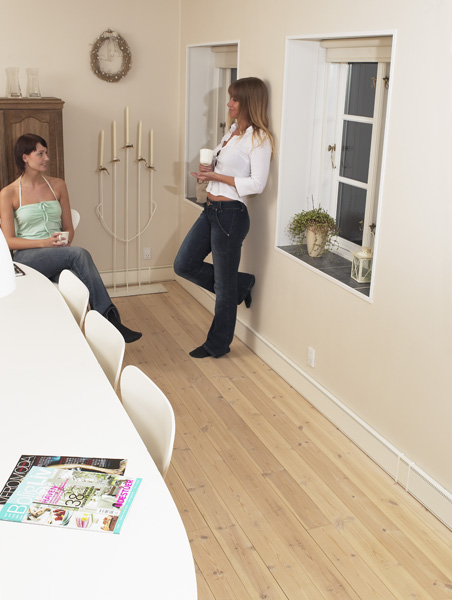
Elpan/Wanpan – energy saving skirting board radiant heating system is based on the principle of the thermal encirclement, which creates a more even distribution of heat throughout the room, as the heat is conducted at a lower temperature.
This is quite different baseboard radiant heating system in comparison to other heating systems such as conventional radiators, baseboard heaters, infloor heating or ceiling heating.
For more information go to: www.wanpan-usa.com.



 THE ULTIMATE HEATING SYSTEM